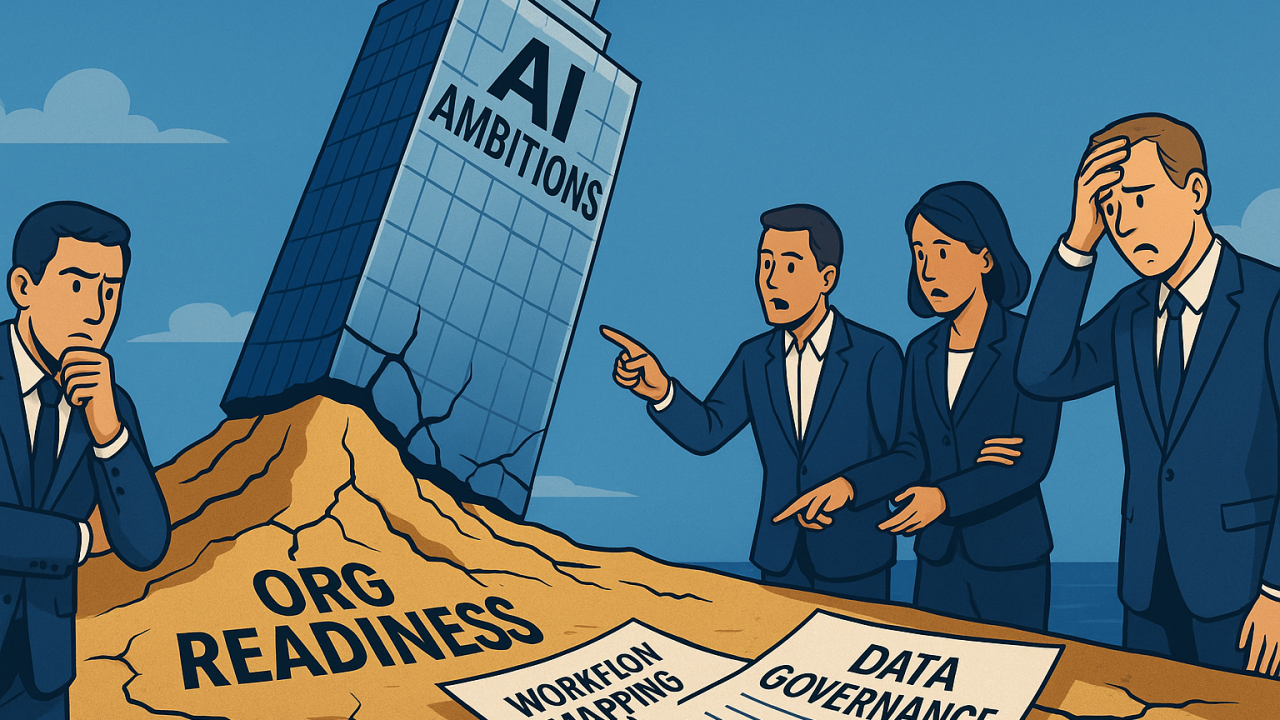
By some estimates cited in RAND research, more than 80% of AI projects fail — twice the failure rate of IT projects that don’t involve AI. These aren’t technology failures — they’re foundation failures.
Recent McKinsey analysis confirms that many companies are “retrenching, rehiring people where agents have failed.” The pattern is consistent and preventable. The companies winning with AI aren’t the ones with the best technology — they’re the ones who fixed their foundations first.
When Titans Fall: The IBM Watson Lesson
IBM Watson for Oncology represents one of the most instructive — and expensive — failures in AI history. IBM spent an estimated $4–5 billion (per press reporting on its acquisition spree) building what was supposed to revolutionize cancer treatment. When it sold the health data assets in 2022, it received roughly $1 billion in return. The MD Anderson partnership alone cost $62.1 million over four years and never treated a single patient.
The core failure wasn’t technical. Watson was trained on synthetic, hypothetical cancer cases rather than real patient data, leading to what clinicians described as “unsafe and incorrect treatment recommendations.” When MD Anderson switched EHR systems mid-project, Watson couldn’t adapt. IBM had never properly mapped the complex realities of healthcare delivery.
This wasn’t an AI problem. It was a readiness problem — and the same readiness problems are playing out across industries today.
The Three Foundational Blind Spots
RAND Corporation analysis of 65 data scientists identified critical failure patterns across AI deployments. Three emerge as the most devastating:
Blind Spot 1: System and Process Mapping
Organizations consistently fail to map their existing systems and processes before deploying AI. They build sophisticated technology on top of operations they don’t fully understand.
McKinsey’s analysis is direct: “It’s not about the agent; it’s about the workflow.” Organizations must fundamentally reimagine entire workflows rather than simply deploying sophisticated tools on top of broken processes. The companies that succeed focus on workflow redesign first, technology second.
Reality Check: How can you improve a process with AI if you don’t know how the process actually works?
Blind Spot 2: The Human Element
Companies consistently underestimate the people and cultural transformation required for AI adoption. RAND research shows that leaders often misunderstand or miscommunicate what problem actually needs solving — a failure that compounds at every subsequent stage.
McKinsey emphasizes that “humans remain essential, but their roles and numbers will change.” That change requires active management. Without addressing the human element — resistance, skill gaps, role redefinition, fear — even technically perfect algorithms get abandoned by the people who are supposed to use them.
Reality Check: AI doesn’t just change technology — it changes how people work. You cannot automate your way past organizational culture.
Blind Spot 3: Integration Architecture and Data Readiness
Organizations pursue AI without proper integration planning, creating technology silos that prevent AI from accessing the data it needs to be useful. The numbers are stark:
- 68% of organizations with less than half their data centralized report lost revenue from failed AI projects
- 29% of enterprises cite data silos as the primary barrier blocking AI success
- Poor data quality costs organizations up to 6% of annual revenue — averaging $406 million for organizations with $5.6 billion in revenue
Reality Check: The most advanced AI models, fed fragmented and ungoverned data through broken integrations, will fail spectacularly. Garbage in, garbage out has never been more expensive.
The Evaluation Infrastructure Gap
McKinsey research highlights evaluation infrastructure as a fourth critical element that most organizations overlook entirely. The comparison to employee development is instructive: companies must “invest heavily in agent development, just like they do for employee development.”
That means detailed performance metrics tied to business outcomes, codifying expert knowledge so AI systems can be evaluated against it, and monitoring systems that track every workflow step — not just final outputs. Without this infrastructure, organizations have no way to distinguish between AI that is performing well and AI that is confidently failing.
What Success Actually Looks Like
Commonwealth Bank of Australia offers a striking counterexample to the failure pattern. After deploying Microsoft Copilot to 10,000 employees, the bank reported that 84% of users said they couldn’t work without it — and that development cycles accelerated by 400%. (The bank’s own numbers — treat them as directional.)
The secret wasn’t superior AI. It was preparation. Commonwealth Bank implemented comprehensive AI governance frameworks and enterprise-wide training programs. Critically, they completed 61,000 data pipeline migrations before deploying AI at scale. The technology deployment came last, not first.
McKinsey’s research confirms this pattern across successful organizations: the common thread is workflow redesign first, AI deployment second.
Julie Sweet’s Framework Challenges Silicon Valley Orthodoxy
Accenture CEO Julie Sweet, whose firm has committed $3 billion to AI over three years, articulates the challenge with unusual directness: “In order to capture the opportunity with AI, you really have to be willing to rewire your company.”
Sweet identifies three red flags that reliably signal AI failure:
- Cross-functional steering committees — “a big red flag” that signals diffused accountability and slow decision-making
- Overemphasis on collaboration as strategy — “another big red flag” when coordination becomes a substitute for transformation
- Impractical projects that won’t demonstrably impact the bottom line
Her summary is direct: “If you’re not changing how you operate, you’re not capturing value.” Structural and operational change is a prerequisite, not a byproduct.
The BCG Framework That Changes Everything
Boston Consulting Group’s research on successful AI implementations revealed a pattern so consistent it became a framework: the 10-20-70 rule.
Leading companies allocate their AI effort as follows: 10% on algorithms, 20% on data and technology, and 70% on people, processes, and cultural transformation. These organizations achieve 2.1 times greater ROI than their peers.
Companies that reverse this formula — focusing primarily on technology and treating people and process as afterthoughts — consistently fail. The ratio is not intuitive to technologists, which is precisely why it gets ignored so reliably.
The Foundation-First Framework
The evidence points to a consistent sequence for successful AI transformation. Organizations that succeed follow four phases in order:
- Foundation Assessment: comprehensive data and systems mapping; document current processes and workflows as they actually operate (not as they are supposed to operate); assess organizational change readiness honestly; identify skill gaps and training needs before making technology decisions
- Infrastructure Preparation: modernize data architecture and governance; optimize and standardize key processes before automating them; implement change management programs; build AI governance frameworks; establish robust evaluation infrastructure so you can measure what’s working
- Pilot Implementation: select high-impact, low-complexity use cases; focus on workflow integration over technical sophistication; apply McKinsey’s decision framework — rule-based automation for repetitive tasks, generative AI for unstructured inputs, predictive analytics for classification problems, autonomous agents only for multi-step decision-making with highly variable contexts; measure adoption and business impact, not just model accuracy
- Scale and Optimize: expand successful pilots to the broader organization; continuously refine processes and capabilities based on real-world feedback; maintain focus on human-AI collaboration rather than replacement; build internal AI competency and culture that doesn’t depend on any single vendor or tool
The Bottom Line
The evidence is overwhelming: AI transformation fails when organizations ignore foundational readiness. The staggering sums being wasted aren’t primarily a technology problem — they’re a fundamental failure to recognize that digital transformation requires organizational transformation first.
Most organizations are trying to solve 2025 problems with 2005 thinking — deploying new tools into old structures and wondering why the results don’t match the demos. IBM spent billions learning this lesson with Watson Health. The companies retrenching today are learning it at smaller scale but no less painfully.
The foundation-first methodology isn’t optional. It’s survival. The companies that thrive in the next decade won’t be those that moved fastest to adopt AI, but those that moved most thoughtfully to prepare for it.