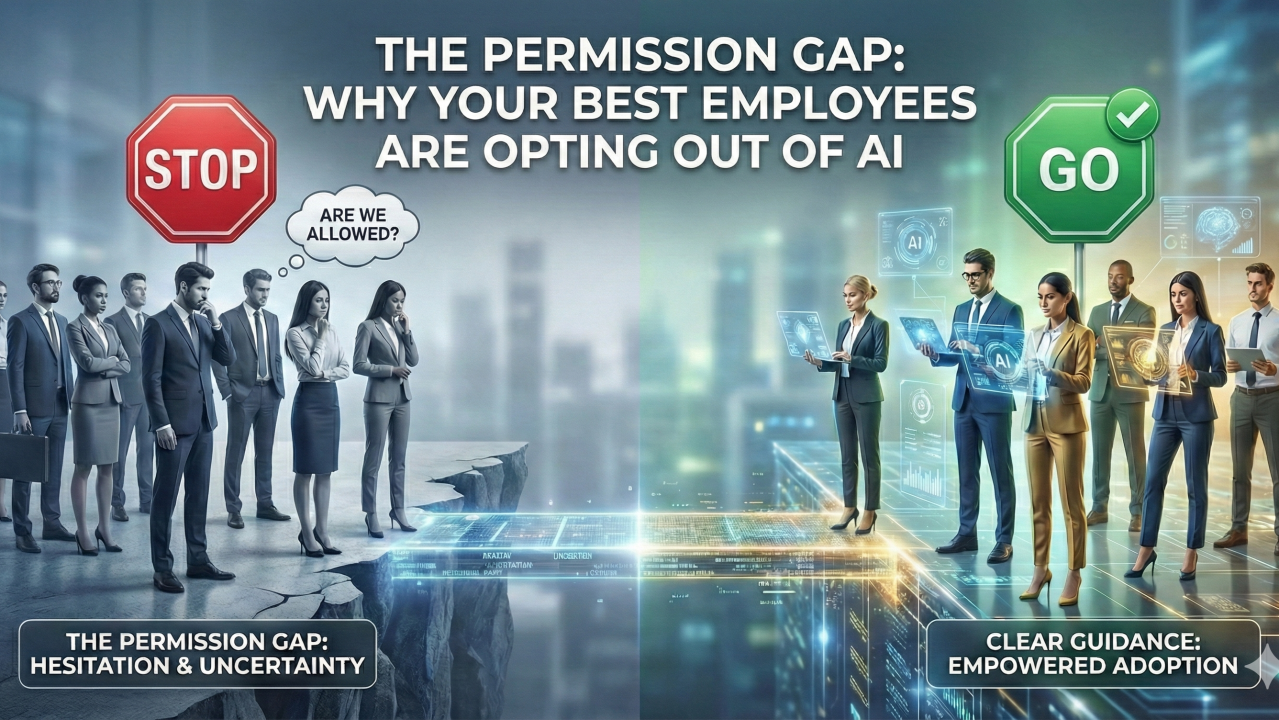
Here's a statistic that should stop every executive in their tracks:
93% of employees who receive AI training use AI in their roles. Among those without training? Just 57%, per research from the London School of Economics and Protiviti.
That's a 36-percentage-point gap. Not because untrained employees can't figure out the tools. Because they don't know if they're allowed to.
I've sat in dozens of AI conversations with teams over the past year. And I can tell you the single most common first question isn't "How do I use this?" or "What can it do?"
It's "Are we allowed to do that?"
If that's your team's first question — if the first thing they think when they think about AI is a giant red stop sign — you've already failed the adoption loop. And here's the painful irony: your most conscientious employees are the ones most likely to opt out. The people who care most about doing good work. Who worry about compliance. Who don't want to make mistakes. Those are exactly the employees you want using AI thoughtfully. And they're the ones your current approach is pushing away.
The Training Chasm
BCG surveyed over 10,600 employees across 11 countries in their 2025 AI at Work study. The findings are damning:
- Only 36% of employees believe their AI training is adequate
- 18% of regular AI users received no training at all
- Only 25% of frontline employees receive leadership guidance on AI use
- Frontline AI adoption has stalled at 51%, down slightly from 2023
Meanwhile, leaders and managers are charging ahead — 72% use AI several times per week. The gap between leadership adoption and frontline adoption isn't closing. It's calcifying.
The Protiviti/LSE study quantified what adequate training delivers:
- Trained employees save 11 hours per week with AI
- Untrained employees save 5 hours per week
- That's more than double the productivity impact
And here's the finding that should reshape your entire talent strategy: training matters more than generation. A Gen X employee who received AI skills training in the past 12 months achieves greater productivity benefits than a Gen Z employee who hasn't been trained. We've been telling ourselves this is a generational adoption problem. It's not. It's an organizational enablement problem.
The Missing 301 Level: Organizational Orchestration
Here's what most organizations fundamentally misunderstand about the AI adoption problem.
You've invested in tool access (101 level: everyone has ChatGPT or Copilot). Some of your people have developed real judgment (201 level: they know when to trust AI, how to integrate it into workflows, where the frontier lies). Your IT team is building infrastructure (401 level: APIs, integrations, security).
But there's a critical layer missing between individual users at 201 and technical teams at 401. Call it the 301 level: organizational orchestration.
301 is about building the organizational systems that let teams use AI together effectively:
- Shared frontier mapping so discoveries don't die with individuals
- Cross-functional workflows so AI outputs flow smoothly between teams
- Governance that enables not just restricts
- Knowledge propagation systems so learning spreads automatically
- Team coordination patterns so everyone knows who verifies what
- Organizational learning so failures are captured and shared
The 93% vs 57% adoption gap? That's a 301 gap. Organizations that invest in organizational orchestration achieve adoption at scale. Those that don't get stuck with brilliant individuals and paralyzed teams.
The Shadow AI Explosion
While conscientious employees hesitate, others have stopped waiting for permission.
Microsoft's 2024 Work Trend Index surveyed 31,000 knowledge workers across 31 countries. 75% of knowledge workers now use AI at work. But 78% of AI users are bringing their own AI tools — personal ChatGPT accounts, Claude subscriptions, tools their company has never vetted. At small and medium-sized companies, the BYOAI rate hits 80%.
BCG's research confirms the pattern: 54% of employees say they would use AI tools even without official authorization. Among Gen Z and Millennials, the number is even higher.
Your careful, thoughtful employees are opting out while your risk-tolerant employees are charging ahead with tools you've never approved, on data you've never secured, with outputs you've never verified.
You're getting the worst of both worlds. The people you want experimenting with AI are paralyzed. The people who should probably slow down and think are operating in the shadows.
The Permission Gap Isn't About Policy — It's About Psychology
Here's what most organizations miss: the permission gap isn't created by unclear policies. It's created by the absence of positive guidance.
Look at how most AI policies are written. They define what data you CAN'T put into AI, what outputs you CAN'T use without review, what risks you need to AVOID. Very few AI policies define what good AI usage looks like. What's encouraged. What success stories exist. What the organization wants people to try.
When all your guidance is negative, your conscientious employees hear: "This is dangerous, stay away." Your reckless employees hear: "There are rules, but I'll probably be fine."
The Microsoft research captured this psychology directly:
- 52% of AI users are reluctant to admit using it for important tasks
- 53% worry that using AI makes them look replaceable
Your best employees aren't just worried about compliance. They're worried about perception. About being seen as taking shortcuts. About having their judgment questioned if the AI makes a mistake. And when leadership doesn't explicitly say "we want you using this" — not just "you're allowed to use this" but "we actively encourage it" — conscientious people default to caution.
Your IT Guardrails Are Stopping the Wrong People
Your IT team implements guardrails on the approved enterprise AI tools. Data classification requirements. Usage logging. Output review processes. All reasonable precautions.
But the employee who's going to paste sensitive customer data into an AI doesn't care about your approved tools. They're using their personal account. Your guardrails don't touch them.
Meanwhile, the employee who would use AI thoughtfully and responsibly looks at all the friction you've added and thinks: "This is too complicated. I'll just do it the old way."
The BCG research found that when leaders demonstrate strong support for AI (not just permission but active encouragement), positive employee sentiment jumps from 15% to 55%. That's not an infrastructure problem. That's a leadership problem.
The Apprentice Problem Nobody's Solving
There's a slower-burning crisis underneath all of this. Junior employees used to develop professional judgment by doing routine work — research tasks, first-draft writing, basic analysis. The unglamorous work that taught people how the domain functions.
That's exactly the work being delegated to AI.
If AI is taking over junior employees' learning opportunities, you need to create new ones. Pair junior people with seniors on frontier-mapping exercises. Make "understanding why AI got this wrong" an explicit development activity. Build judgment deliberately rather than hoping it develops accidentally.
If you're not deliberately developing the next generation of frontier-mappers, you're building an organization that will lose the expertise that makes AI effective.
301 Capabilities: Breaking Through the Permission Gap
1. Enabling Governance
Rewrite your AI policy to lead with what's encouraged. "We want you using AI for these task types. Here's what good looks like. Here are success stories from teams like yours." Put the positive guidance first, the restrictions second.
2. Coordination Patterns
It's not enough for the CEO to say "we're an AI-first company" in a town hall. Frontline employees need to see their direct managers using AI, talking about AI, encouraging AI experimentation. The BCG data shows only 25% of frontline employees feel they receive adequate leadership guidance on AI. That's a massive gap between executive enthusiasm and frontline enablement.
3. Learning Systems
Run low-stakes AI competitions. "What's a workflow you improved this month using AI?" Make it normal to try things, share results, and yes, share failures. When people see their peers experimenting without negative consequences, permission becomes implicit.
4. Knowledge Propagation
Trek Bicycle's approach — interviewing every department about how AI might improve their work — generated over 40 concrete use cases. Your organization has similar hidden knowledge, but someone has to surface it.
5. Organizational Learning
Track whether AI is integrated into actual workflows. Whether people are iterating on outputs or accepting first drafts. Whether failure cases are being documented and shared. Whether the frontier map is getting more accurate over time.
The Real Cost of the Permission Gap
The Protiviti/LSE research found that AI users save an average of 7.5 hours per week — roughly one full workday. At average knowledge worker compensation, that's approximately $18,000 per employee per year in productivity gains.
For every 100 employees:
- With training: 93 employees × $18,000 = $1.67M in productivity gains
- Without training: 57 employees × $9,000 = $513K in productivity gains
That's over $1 million per 100 employees left on the table. The permission gap isn't a minor HR issue. It's a strategic vulnerability.
Your employees are already using AI. The 78% BYOAI statistic proves it. The question isn't whether AI will reshape your work. That's already happening. The question is whether it happens in ways you can see, govern, and improve — or in shadows, with your most thoughtful employees sitting on the sidelines.
Your conscientious employees are waiting to be told it's okay to try.
Tell them.