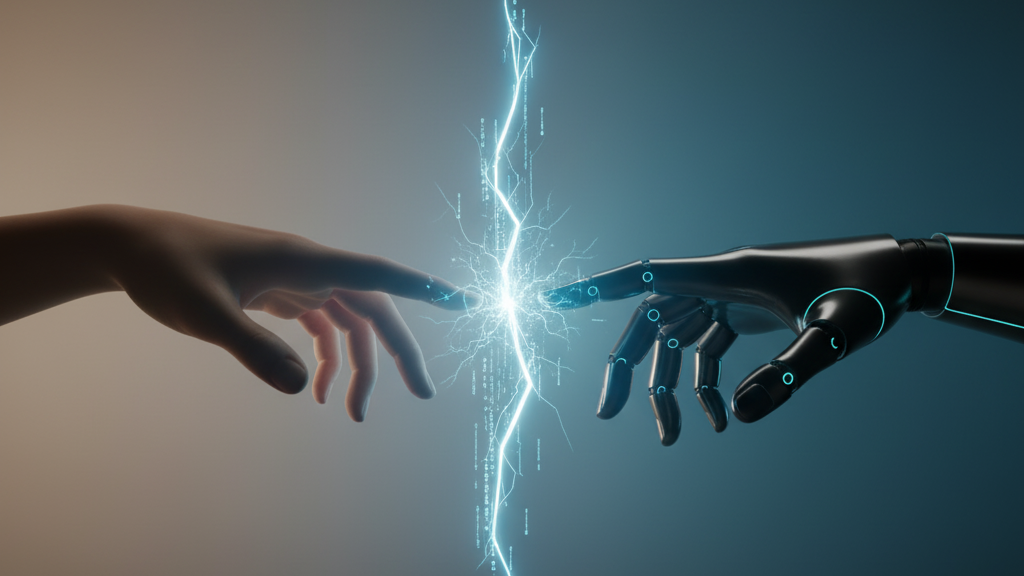
Salesforce CEO Marc Benioff announced his company won’t hire software engineers in 2025 after claiming 30% productivity gains from AI. Goldman Sachs projects 300 million jobs globally are exposed to AI automation. Yet MIT research reveals a counterintuitive truth: human-intensive tasks actually increased from 2016 to 2024. One critical question: Which side of the jagged frontier will you be on?
The displacement has begun. When one of the world’s largest software companies announces a complete engineering hiring freeze during a tech boom, something fundamental has shifted. Yet within this disruption lies an extraordinary opportunity. While Goldman Sachs economists project 300 million full-time jobs exposed to automation worldwide, MIT research from 2024 reveals that human-intensive tasks requiring empathy, presence, opinion, creativity, and hope have actually increased in both quantity and frequency over the past eight years.
We’re standing at what Harvard researchers call the “jagged technological frontier” — an irregular edge where AI excels brilliantly at some tasks while failing completely at seemingly similar ones. Your career depends on understanding which side of that jagged edge you occupy.
The Great Divide: Mapping the Jagged Frontier
Harvard Business School’s landmark study with BCG involving 758 consultants reveals this jagged frontier in precise detail. When working within AI’s strengths, consultants completed 12.2% more tasks, worked 25.1% faster, and produced 40%+ higher quality results. But for tasks outside that frontier, consultants using AI were 19 percentage points less likely to produce correct solutions. This isn’t a smooth technological progression — it’s a jagged, unpredictable edge where extraordinary capability sits next to complete failure.
Research Revolution: What Science Says About Human Value
The largest global study of AI’s impact on human skills, conducted by Workday across 2,500 workers in 22 countries: 83% of respondents believe AI will actually elevate the importance of uniquely human skills. The research identified skills deemed least likely to be replaced by AI: ethical decision-making (ranked #1), relationship building, emotional intelligence, and conflict resolution. These aren’t soft skills anymore — they’re becoming the hardest currency in the AI economy.
MIT’s comprehensive analysis using their EPOCH framework (Empathy, Presence, Opinion, Creativity, Hope) found that human-intensive tasks are not only surviving but growing. Tasks that “cannot be done effectively entirely by machines” have increased across industries from 2016 to 2024.
The Five Domains Where Humans Still Win
Based on converging research from Harvard, MIT, Workday, and multiple academic studies, five domains emerge where humans maintain not just relevance, but monopoly:
1. Judgment in Ambiguity
AI excels with clear patterns. It fails when patterns don’t exist or when ethical considerations override data-driven conclusions. Strategic decisions in uncertain environments — choosing between two good options or two bad ones — require human wisdom that no algorithm can replicate. MIT’s research shows that tasks involving “determining scientific or technical goals within broad outlines” remain fundamentally human-intensive. When the data points nowhere, human judgment becomes priceless.
2. Trust and Accountability
The Workday study revealed that relationship building ranks among the skills most resistant to AI replacement. In complex business environments, the bottleneck isn’t information — it’s building trust, aligning stakeholders, and creating commitment across diverse groups. When human stakes are high, humans demand human accountability. AI can recommend, but someone must be responsible for the consequences.
3. Emotional Intelligence and Empathy
While AI can recognize emotional patterns in data, MIT’s EPOCH framework confirms that genuine empathy — requiring presence and authentic human connection — remains irreplaceable. Research consistently shows that people prefer human empathy once they realize responses are AI-generated. This isn’t about recognizing emotions. It’s about feeling them, understanding their context, and responding with authentic care.
4. Creative Problem-Solving
Human creativity involves breaking conventional rules, drawing from subjective experiences, and making intuitive leaps that surprise even the creator. AI optimizes within parameters; humans reimagine the parameters themselves. MIT’s research on “opinion” and “creativity” as human-intensive capabilities shows these skills becoming more valuable, not less, as AI handles routine creative tasks.
5. Critical Thinking and Adaptability
A study by Michael Gerlich involving over 600 participants found a significant negative correlation (−68%) between frequent AI tool usage and critical thinking abilities. The mechanism? Cognitive offloading — when humans delegate thinking to machines, those cognitive muscles atrophy. However, the study also revealed that individuals with higher education maintained stronger critical thinking abilities even when using AI, suggesting that how we use AI matters more than whether we use it.
The Value Migration That Changes Everything
We’re witnessing the largest value migration in modern economic history. PwC’s 2025 Global AI Jobs Barometer reveals that workers with AI skills now command a 56% wage premium — more than double the 25% premium from just one year ago. AI-exposed industries achieve 3x higher revenue growth per employee than less exposed sectors.
The crucial insight: this value doesn’t flow to AI — it flows to humans who master human-AI collaboration while maintaining their irreplaceable capabilities.
The World Economic Forum’s 2025 Future of Jobs Report, surveying over 1,000 global employers representing 14 million workers:
- 170 million new jobs will be created by 2030
- 92 million jobs will be displaced
- Net result: 78 million new positions globally
- 39% of job skills will change by 2030
The gap between AI capability and human wisdom is where extraordinary value gets captured. Yet 63% of employers cite skill gaps as their primary transformation barrier.
The Productivity Paradox Nobody’s Talking About
The uncomfortable truth: AI is making workers simultaneously more productive and potentially less capable. Gerlich’s research reveals that frequent AI usage correlates with weaker critical thinking, particularly among younger users who show the highest AI dependence.
Like physical muscles, our capacity for judgment, creativity, and critical thinking requires active use to remain strong. The organizations capturing real value from AI understand this paradox. They use AI for data processing and pattern recognition while fiercely protecting human ownership of:
- Contextual awareness to know when to trust or question AI outputs
- Stakeholder relationships that require genuine trust
- Strategic decisions where ethics matter more than efficiency
- Change leadership to help teams navigate uncertainty
- Creative direction that shapes culture and meaning
Your Jagged Frontier Audit
Based on the research findings, honestly assess where you stand on the jagged frontier:
- When did you last make a decision that went against what data suggested because it felt ethically wrong?
- Can you help teams find purpose and meaning when facing uncertainty?
- Do colleagues seek you out during ambiguous situations that require human judgment?
- Have you solved problems using intuitive leaps that surprised even you?
- Can you build trust through authentic connection, not just competence?
Your strongest capabilities reveal your position on the human side of the jagged frontier. Your weakest become urgent development priorities.
The Path Forward: Mastering the Human Edge
The future belongs not to those competing with AI, but to those who amplify what makes us irreplaceable:
- Develop: The judgment to make decisions when data fails or ethics override efficiency
- Build: Trust-based relationships that transcend transactions and create genuine commitment
- Exercise: Creative thinking that reimagines parameters rather than optimizing within them
- Strengthen: Emotional intelligence that connects authentically with human experience
- Maintain: Critical thinking skills through deliberate practice and conscious cognitive engagement
You become the bridge between computational power and human purpose, between efficiency and ethics, between what’s possible and what matters.
MIT’s data shows human-intensive capabilities are increasing in importance. Workday’s global study confirms that 83% of workers are ready to embrace this reality. The research has spoken: the last human skills aren’t disappearing. They’re becoming the most valuable assets in the new economy.
The jagged frontier isn’t a threat — it’s a map. The question isn’t whether AI will transform your industry — it already is. The question is whether you’ll develop and own the human capabilities that remain irreplaceable on your side of the frontier.
Marc Benioff made his bet: humans plus AI outperform humans alone. Goldman Sachs mapped the scale of transformation. MIT proved human skills are growing more valuable, not less. The research shows the path. Which side will you claim?