75% of knowledge workers are already using AI. Nearly half started in just the last six months. Yet simultaneously, 45% worry AI will replace their jobs. Among those actively using AI? 53% worry that using it makes them look replaceable.
This paradox — using the tool you fear will replace you — isn't confusion. It's transformation occurring in real-time.
New research suggests that while this anxiety is normal, how we process it determines our career survival. Studies tracking professionals through career disruption show that approximately 80% avoid complicated grief, processing the change in healthier ways when they have the right frameworks. You don't need to be a tech wizard to join that 80%. You just need to understand the psychological shift happening right now.
The Grief No One Discusses
When AI completes in seconds what took you years to master, you aren't just learning a new workflow. You're grieving an identity.
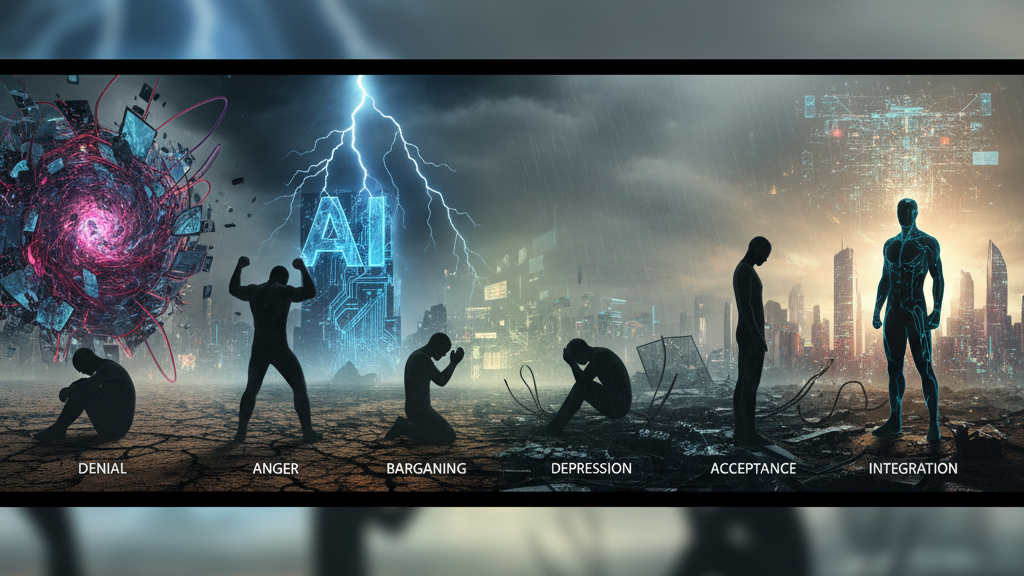
UC San Diego's Benjamin Bratton maps this through the “Five Stages of AI Grief”:
- Denial: “AI can't really do what I do”
- Anger: “This is destroying my craft”
- Bargaining: “We can control this with regulations”
- Depression: “We are all doomed”
- Acceptance: “This is the new reality”
But Bratton identifies a critical sixth stage: “Non-Grief.” This is where you transcend the fear of loss and see transformation for what it is: neither utopian nor dystopian, but open to “radically weird possibilities.”
Most professionals are stuck in stages 1–4. Your company wants you at stage 5. The real opportunity is stage 6: where AI becomes your capability multiplier, not your replacement.
The “90-Day” Myth Your Company Is Selling
To reach Stage 6, you must ignore the corporate timeline.
Your company promises “90-day AI transformation,” seeking quick wins and rapid adoption. Career transition experts — including Herminia Ibarra who tracked 39 professionals through major reinventions — consistently observe that meaningful professional transformation takes 12–18 months.
Identity reconstruction is a gradual process. It requires experimentation, failure, and integration.
“The Lie: ‘Master this by next quarter.’ The Truth: ‘Transformation takes 12–18 months. But you must start today.’”
The danger isn't the long timeline — it's using that timeline as an excuse to delay starting.
The Data: Democratization vs. Calibration
1. The Democratization of Excellence (The Good News)
Harvard and BCG ran an experiment with 758 consultants using GPT-4. The results were counterintuitive:
- Top performers improved by 17%
- Lower performers improved by 43%
AI didn't replace the job — it raised the floor. The junior analyst becomes a strategic advisor. The hesitant writer becomes a prolific communicator. If you've ever felt you weren't reaching your potential, AI is your equalizer.
2. The Trap of Over-Reliance (The Warning)
An MIT meta-analysis of 370 experiments found that in certain contexts, human-AI teams performed worse than either alone. Why? Calibration. When humans blindly trust AI in areas where it lacks context or ethical judgment, performance degrades. The most valuable skill of the next decade isn't prompt engineering — it's meta-cognition: knowing exactly when to trust the machine and when to trust your gut.
The 4 Psychological Superpowers That Predict Success
Meta-analysis of 51 studies covering 12,567 employees found the professionals who thrive score higher on four psychological resources. The breakthrough? These aren't fixed traits — research shows 2–3 hour interventions can meaningfully improve them.
- HOPE = Agency + Pathways. Multiple routes to goals you believe you can take.
- EFFICACY = Task-specific confidence. “I can master THIS tool, THIS skill.”
- RESILIENCE = Using setbacks as launching pads, not roadblocks.
- OPTIMISM = Strategic interpretation. Bad things are temporary. Good things are permanent.
The Identity Shift That Changes Everything
How do you build the judgment to know when to trust AI? Change how you define your value.
The Task-Based Identity (High Risk):
- “I write code”
- “I analyze data”
- “I create reports”
The Purpose-Based Identity (Future-Proof):
- “I write code” → “I solve problems that unlock business value”
- “I analyze data” → “I find patterns others miss”
- “I create reports” → “I make complexity simple for decision-makers”
Same job. Revolutionary reframe. Career secured.
The Reality of Your 18-Month Journey
Career researchers consistently find three overlapping phases, not neat monthly milestones:
Phase 1 (Months 1–6): The Chaos Zone
You'll oscillate between excitement and panic. Some experiments will fail spectacularly. This is normal. Focus on:
- Small, low-risk AI experiments at work
- Building psychological resources (hope, efficacy, resilience, optimism)
- Processing the grief of your changing identity
Phase 2 (Months 6–12): The Experiment Phase
Multiple possibilities emerge. You're testing different versions of your future self:
- Running parallel experiments with different AI tools
- Finding your calibration point (when to trust AI vs. human judgment)
- Building reputation as an early adopter
Phase 3 (Months 12–18): Integration
Your new identity crystallizes through action, not planning:
- AI augmentation becomes natural part of workflow
- You're teaching others what you've learned
- New opportunities appear that didn't exist 18 months ago
This isn't a linear journey. You'll cycle through phases, have setbacks, and surprise breakthroughs. That's the process working.
The Monday Morning AI Test (90 Seconds to Start)
Don't wait for the “perfect time” to begin your transformation. Start the 18-month journey with 90 seconds of action today.
- Identify the Grind: Look at this week's to-do list. Circle one repetitive, draining task.
- The AI Pivot: Spend 60 seconds researching how AI could handle the first draft.
- The Commitment: Open a tab for that tool right now. You don't have to master it today. Just open the door.
Result: You stop being someone who fears the future and become someone who shapes it.
The Choice You're Making Today
In a study of 5,179 customer support agents, AI assistance increased productivity 14% and improved retention. Why? It eliminated soul-crushing work, allowing humans to be human.
The 80% who avoid career grief don't have more information than you. They have more experiments running. Every day you delay starting, you're not “being strategic.” You're choosing the 20% path.
Start today:
- Do the Monday Morning Test above (90 seconds to begin)
- Commit to the real timeline: 12–18 months of evolution
- Share one insight about starting your journey
- Connect with one person already on the path
Because in 18 months, you'll either be explaining how AI made you irreplaceable, or explaining why you waited for the “right time” to start. The transformation takes 18 months. The first step takes 90 seconds.