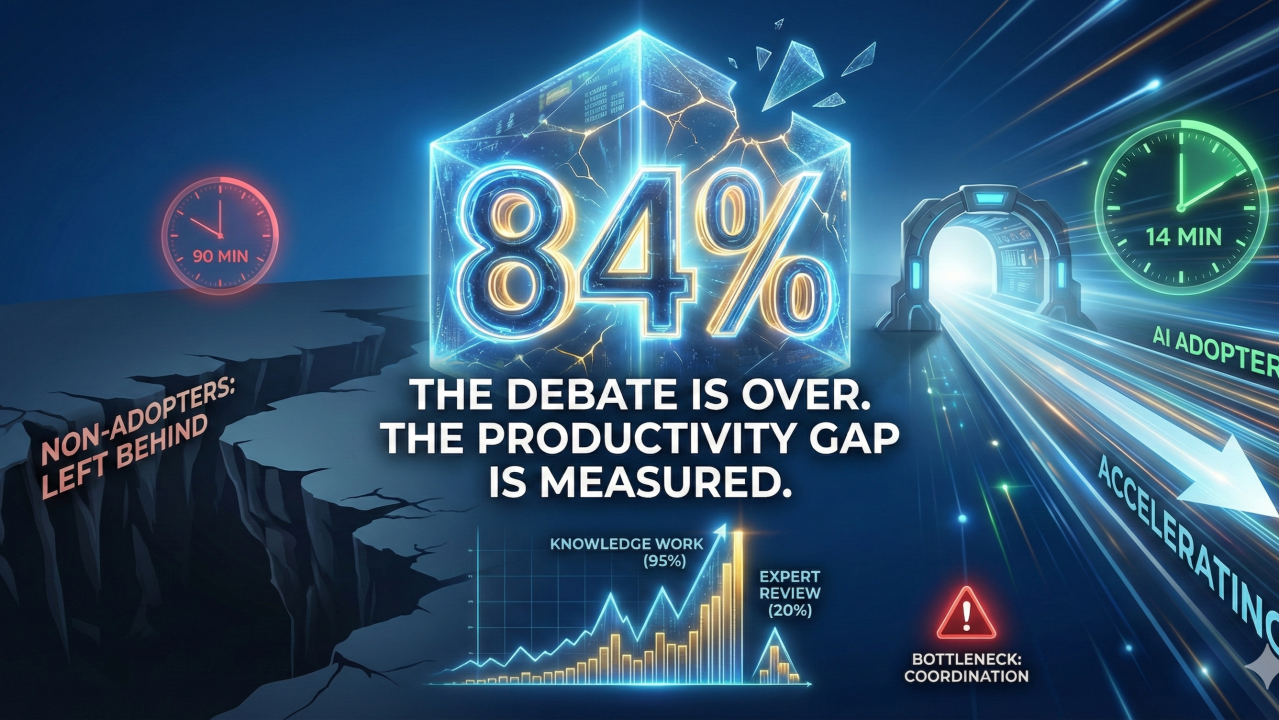
The debate is over.
Anthropic just measured 100,000 real conversations between humans and AI, tracked how much time each task would take without assistance, and calculated the difference.
The result? A median 84% time savings across tasks.
The average professional task that would take 90 minutes now takes 14 minutes with AI assistance. Not in a lab. Not in a controlled study. In actual work, across actual occupations, with real people.
For years, AI productivity was a prediction. A hope. A consultant's forecast. That uncertainty ended November 25, 2025.
95% Faster — Or 20% Faster. The Variance That Changes Everything.
Here's what the 84% average obscures: AI productivity gains follow a jagged pattern.
Curriculum development tasks that would take teachers 4.5 hours now take 11 minutes — a 95% time savings. Compiling information from reports sees similar acceleration. AI reads, extracts, and synthesizes faster than any human can scan a document.
Invoice creation, memo writing, and document preparation run 87% faster. Financial data interpretation hits 80% time savings.
But checking diagnostic images? Only 20% faster, because experts already do this quickly without assistance. Hardware troubleshooting? 56%. Some tasks simply don't compress the way knowledge work does.
Same technology. Wildly different results depending on the task.
The research also reveals what people attempt with AI varies by profession. Management and legal professionals bring AI tasks that would take nearly 2 hours to complete manually. Food preparation and maintenance workers bring tasks averaging 30 minutes. People in complex knowledge work aren't just using AI more often — they're using it for bigger problems.
Translation: Your AI strategy can't be “deploy everywhere.” It needs to target the 80–90% opportunity zones while acknowledging the areas that won't transform.
The Bottleneck Paradox: When Speed Creates New Constraints
Here's the uncomfortable reality buried in this research: The faster AI makes some tasks, the more other tasks become bottlenecks.
A developer who writes code 80% faster but still sits in the same coordination meetings hasn't transformed their productivity. They've just shifted the constraint.
An analyst who generates insights 87% faster but waits days for stakeholder decisions hasn't revolutionized the business. They've exposed where the real friction lives.
Anthropic's research presents this as the “acceleration-constraint paradox.” As AI removes one bottleneck, you immediately expose the next one. And those next bottlenecks often aren't technological. They're organizational, interpersonal, or structural.
The measurement isn't “how much faster did we complete Task X?” The measurement is “how much faster did we deliver outcome Y?” If Task X accelerates but the workflow around it doesn't, you've gained efficiency without gaining speed.
This creates a new strategic imperative: bottleneck hunting. After you deploy AI and measure the task-level acceleration, immediately map what slowed down relatively. That's your next target. It might be another AI application. It might be process redesign. It might be removing approval layers or restructuring decision rights.
The organizations that treat AI as “we sped up these 12 tasks” will plateau quickly. The organizations that treat AI as “we revealed these 8 new constraints to eliminate” will compound their advantages.
The Broader Economic Impact
The research reveals one more crucial insight about AI's broader economic impact.
If these productivity gains hold at scale, AI could contribute 1.8% annual productivity growth to the US economy. That sounds modest until you realize that software developers, despite all their AI gains, contribute only 19% of the total impact.
Most of the productivity boost comes from everyone else using AI for everyday work.
This validates what economists Aghion, Jones, and Jones identified: the real constraint on AI's economic impact isn't the technology's capability. It's whether businesses can reorganize fast enough to actually capture the gains.
Anthropic's measurement confirms we're past the capability question. AI works. The productivity gains are real and measurable. What's unproven is whether your organization can move fast enough to benefit before someone else does.
What This Means for Your Organization
1. Stop Waiting for More Proof
The measurement threshold has passed. You can no longer argue that AI productivity gains are theoretical. One hundred thousand conversations say otherwise. The question is whether you'll capture those gains before your competitors do. Every month of delay widens the gap between you and organizations already committing to these advantages.
2. Deploy Surgically, Not Uniformly
Uniform deployment is a mistake. The research shows massive variance across tasks. Deploy AI where it provides 80–90% gains: knowledge work, document creation, analysis, and synthesis. Don't waste resources chasing 20% improvements in areas where AI barely moves the needle. Your first move should be an honest task audit: Where does your organization actually spend time, and which of those tasks fall into the high-gain categories?
3. Make Bottleneck Hunting Your New Discipline
Bottleneck identification becomes your new discipline. Once you've accelerated the AI-friendly tasks, map what's constraining throughput. That's your next optimization target, whether it requires different AI applications, process redesign, or human capability investment. Build this into your operating rhythm. The companies that stop at “we deployed AI” will see bounded gains. The companies that systematically hunt bottlenecks will see transformation.
4. Restructure Operations, Don't Just Speed Them Up
Restructuring separates leaders from followers. The research is clear: historically, the biggest productivity gains came from reorganizing operations around new technology, not just speeding up old processes. Companies that use AI to write reports faster will see improvements. Companies that ask “why do we write these reports at all, and what decisions do they enable?” will see revolution. The question isn't “how do we do this faster?” It's “what becomes possible that wasn't before?”
5. Reinvent Talent Development Before Your Pipeline Dries Up
Talent development requires reinvention. If AI handles the tasks that trained your future leaders, you need new approaches to mentorship, learning, and career progression. This isn't optional. How will your junior employees develop judgment when AI handles the reps they used to get? The organizations that answer this question will have sustainable talent advantages. The companies that ignore it will wonder in five years why their leadership pipeline dried up.
The Choice Is Yours
Anthropic measured 100,000 real conversations. 84% median time savings. Task-by-task variance mapped. Bottleneck dynamics documented. Economy-wide implications calculated.
Your competitors have the same data you're reading right now.
The organizations acting on it — mapping high-gain tasks, identifying emerging bottlenecks, redesigning workflows around AI-accelerated work — are creating compounding advantages. The organizations waiting for more proof will spend five years catching up.
The productivity gap between AI adopters and non-adopters is no longer theoretical. It's measurable, it's wide, and it's growing every day you delay.
The proof is here. What happens next is up to you.