The Consumer Electronics Show just delivered a verdict nobody wanted to hear.
Dell’s head of product Kevin Terwilliger told PC Gamer something remarkable: “What we’ve learned over the course of this year, especially from a consumer perspective, is they’re not buying based on AI. In fact I think AI probably confuses them more than it helps them understand a specific outcome.”
One of the world’s largest PC manufacturers just admitted that AI marketing confuses rather than converts. This confession arrived at an event where every major tech company was still pushing AI-everything messaging. But Dell’s honesty reflects a broader shift happening across enterprise technology: the party is over for AI experimentation. We’re now entering what I call the “Outcomes Era” — where the entire industry is pivoting from “look what AI can do” to “show me what AI has done.”
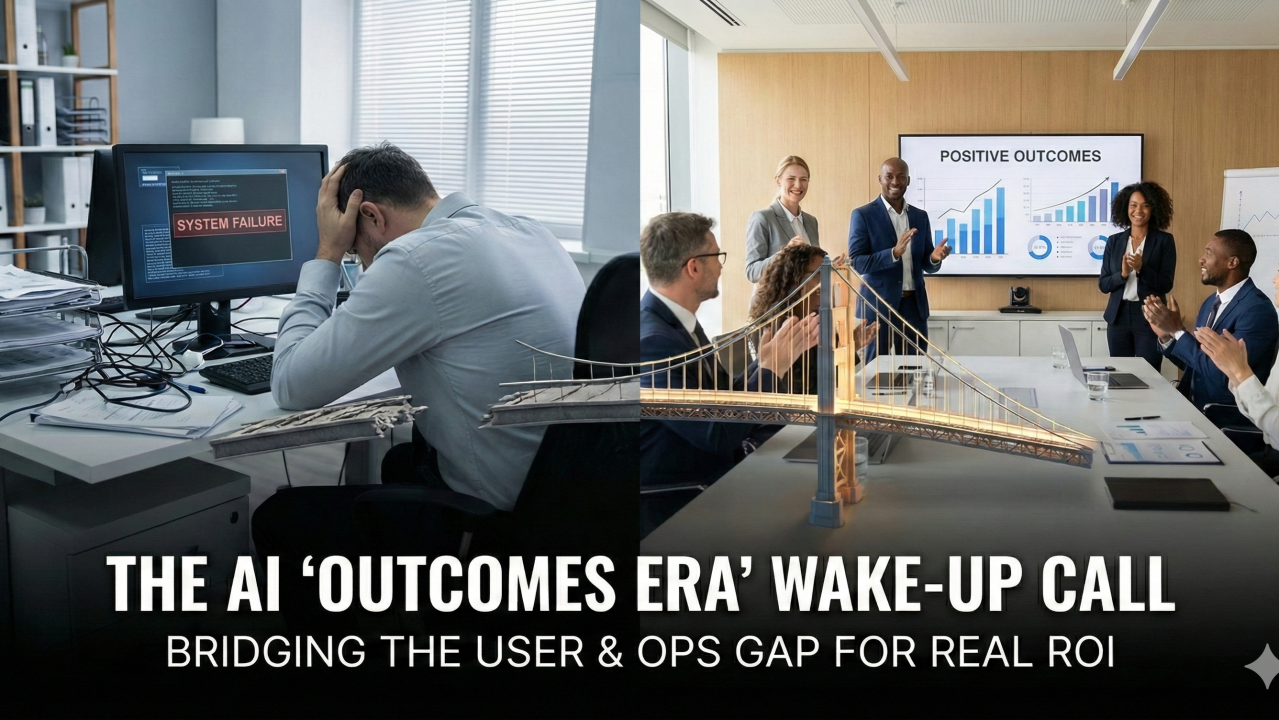
Here’s the uncomfortable truth: The AI adoption crisis isn’t primarily a technology problem. It’s a user adoption and operations readiness problem. And until executives understand this distinction, they’ll keep investing in capabilities nobody uses and infrastructure that delivers no returns.
The Metrics That Should Terrify Every CTO
Consider the data:
- Microsoft’s flagship AI product, Microsoft 365 Copilot, reportedly has only 8 million active licensed users against 440 million potential Microsoft 365 subscribers — a conversion rate under 2%.
- Research from METR (Model Evaluation and Threat Research) found that experienced developers using AI tools took 19% longer to complete tasks — while believing they were 20% faster. That’s a 39-point gap between perception and reality.
- While 78% of workers report using AI in their jobs, only 23% of companies are measuring any return on their AI investments.
Translation: Companies are deploying AI at unprecedented scale while completely failing to capture value from it.
Gartner recently predicted that over 40% of agentic AI projects will be cancelled by the end of 2027, citing “escalating costs, unclear business value, or inadequate risk controls.”
The User Adoption Chasm: Why Your AI Investments Aren’t Working
Problem #1: Employees don’t know how to use AI effectively
Most AI rollouts follow a familiar pattern: purchase enterprise licenses, send an announcement email, expect productivity to magically increase. Worklytics research reveals the reality: even among companies that have rolled out Copilot to 50% or more of their workforce, actual daily usage often hovers below 25%. Licenses don’t equal adoption. Training announcements don’t equal competency. The skills gap is enormous. Workers need to learn entirely new ways of working — prompt engineering, context management, output validation — skills that didn’t exist two years ago.
Problem #2: Process maturity hasn’t caught up
You can’t deploy AI effectively on broken processes. Yet most organizations are trying to layer AI on top of workflows that were never designed for it. Consider the prerequisites for successful AI deployment:
- Data quality: Does your information exist in clean, accessible formats?
- Process documentation: Do you actually know how work gets done today?
- Governance frameworks: Who approves AI-generated outputs? Who’s accountable when it’s wrong?
- Integration capability: Can your systems actually connect to AI tools?
The companies seeing 80% AI project failure rates aren’t failing because of technology. They’re failing because they skipped the foundation-building that makes AI useful.
The AI Value Hierarchy: What Must Happen Before Outcomes Materialize
Every organization rushing to deploy AI is encountering the same barrier: you can’t extract value from capabilities nobody uses, embedded in processes that don’t work.
Level 1: Access (Necessary but insufficient)
You’ve purchased licenses. AI tools are technically available. This is where most companies stop — and where most value evaporates.
Level 2: Adoption (The critical gap)
Employees actually use the tools regularly and correctly. This requires training investment, workflow redesign, and sustained change management. Most enterprises are stuck between Level 1 and Level 2.
Level 3: Integration (Operations territory)
AI is embedded into actual workflows, not bolted on as an afterthought. This demands process documentation, data quality, and governance frameworks most companies lack.
Level 4: Optimization (The outcomes everyone wants)
AI-enabled workflows are continuously measured and improved. But you can’t optimize what you haven’t adopted, integrated, and instrumented.
Most companies are investing at Level 4 while their organizations are stuck at Level 1.
The Process Maturity Matrix: Where Your AI Will Succeed or Fail
Not all processes are ready for AI, and not all AI applications are created equal. A realistic assessment requires mapping process complexity against process maturity.
Mature processes with low complexity — think data entry, basic document generation, standardized reporting. These are your quick wins. Deploy AI, measure results, capture value immediately.
Mature processes with high complexity — like customer service with multiple exception paths, or financial analysis requiring judgment. These need “human-in-control” AI (a framing coined by Amy Swaner) — augmentation rather than automation.
Immature processes — regardless of complexity — need foundation work before AI. If you can’t document how a process works today, you can’t train AI to do it better.
The RPA revolution already demonstrated this truth: automation deployed on broken processes just breaks things faster. AI amplifies this effect by orders of magnitude.
The honest assessment most organizations need: How many of your critical business processes are actually documented, measured, and optimized? If the answer is “few” — and it usually is — you’ve identified your real AI readiness problem.
The Training Imperative: Why AI ROI Starts With People
Companies that invest heavily in AI training see dramatically different results:
- Bank of America reported 25% cost reduction through AI-enabled training programs
- Chevron saw 30% higher engagement
- Microsoft achieved 85% completion rates on AI-enhanced learning programs
- DHL documented 50% cost reductions
Yet Forrester predicts that by 2026, only 30% of organizations will mandate AI fluency as a core competency. Translation: 70% of organizations will continue failing at AI adoption because they’re not treating it as a skills development challenge.
The companies winning at AI aren’t buying better technology. They’re building better capabilities in their people. They’re creating:
- Structured AI literacy programs, not one-time tool demonstrations
- Role-specific prompt libraries and use case playbooks
- Feedback loops that capture what works and scale it
- Career pathways that reward AI proficiency
The Governance Gap: Why Progress Stalls Without Guardrails
Gartner’s research reveals another hidden blocker: governance delays are adding 6–12 months to enterprise AI deployments.
Organizations are legitimately concerned about:
- Data security: What happens when AI tools have access to sensitive information?
- Compliance risk: Who’s liable when AI generates incorrect outputs?
- Quality control: How do you validate AI-generated work at scale?
- Intellectual property: Who owns what AI creates using company data?
But here’s the paradox: the organizations moving slowest on governance are also the ones deploying AI fastest. The result is shadow AI usage, untracked tools, inconsistent outputs, and zero measurable ROI.
What mature organizations do differently: They build governance frameworks that enable experimentation rather than prevent it. They create sandbox environments for AI testing. They establish clear ownership for AI-related decisions. They instrument usage from day one so they can actually measure what’s working.
The AI Opportunity Matrix: Targeting Value, Not Hype
Given finite resources, where should executives focus?
- High value, high readiness: Processes that are well-documented, regularly performed, and have clear success metrics. These are your immediate AI opportunities. Stop debating and deploy.
- High value, low readiness: Important processes that lack documentation or data quality. These need foundation work before AI. Invest in process improvement first, then AI-enable.
- Low value, high readiness: Easy wins that don’t move strategic needles. Automate if the ROI math works, but don’t mistake activity for impact.
- Low value, low readiness: Where most experimental AI projects live. These become the 80% failure statistics. Avoid or aggressively de-prioritize.
The companies succeeding at AI aren’t trying everything. They’re ruthlessly prioritizing based on organizational readiness and business value.
The Path Forward: From Outcomes Theater to Actual Outcomes
CES 2026 marked the industry’s acknowledgment that AI hype has exceeded AI results. But the solution isn’t abandoning AI — it’s finally doing the work that makes AI successful.
For executives:
- Shift investment from AI technology to AI enablement — training, process readiness, governance
- Demand adoption metrics, not just deployment metrics
- Fund the foundation work that makes AI sustainable, not just the experiments that make good press releases
For operations leaders:
- Assess process maturity before advocating for AI investment
- Build measurement frameworks that track actual value creation
- Own the integration work that determines whether AI capabilities become business outcomes
For technology leaders:
- Stop treating AI deployment as the finish line
- Create feedback loops between users and AI tools
- Instrument everything so you can actually answer “is this working?”
The Outcomes Era isn’t just about demanding results. It’s about building organizations capable of producing them.
Dell’s admission at CES wasn’t just about marketing strategy. It was an acknowledgment that the entire industry has been selling AI capabilities while customers need AI outcomes. The companies that thrive in the Outcomes Era won’t be the ones with the most advanced AI technology. They’ll be the ones that solved the user adoption problem. The ones that did the process maturity work. The ones that built governance frameworks that enable rather than prevent progress.
Every AI investment you’ve already made is waiting for these foundations to unlock its value. The technology is ready. The question is whether your organization is.